
Psalm 30:5
Hellbender 100 — Part 2 of 3

There comes a point in a hundred-mile race when preparation stops carrying the weight.
Not completely. The training matters. The miles matter. The strength work matters. But eventually you reach a place where the spreadsheets, the plans, the workouts, and all the confidence they produced can no longer carry you. At some point you stop running the race you imagined and start dealing with the reality in front of you.
For me, that happened somewhere in the back half of Hellbender.
The front fifty miles felt almost magical.
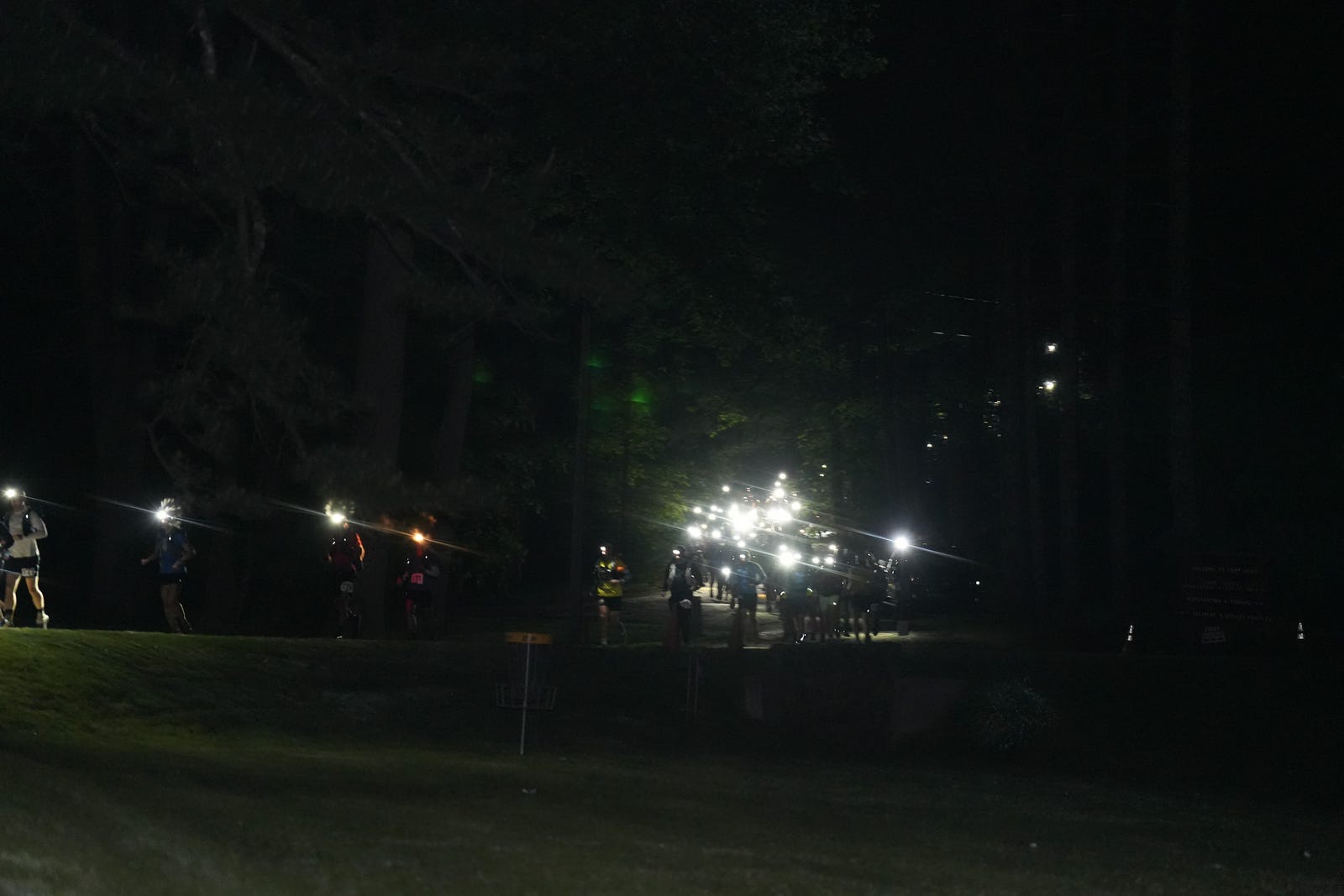
We started in darkness, hundreds of small lights bouncing through the mountains of Western North Carolina.
The air was cool and still, carrying the smell of wet earth, pine needles, moss, and decaying leaves.
Headlamps danced across endless roots and rocks, illuminating just enough trail to keep moving forward. Through breaks in the trees I could see stars overhead.
As the night gave way to morning, the birds slowly joined in. One call became several. Then dozens.
Spring flowers emerged with the sunrise, revealing colors that had been hidden in darkness just moments before.
Every turn seemed to reveal another reminder that creation is alive and constantly pointing beyond itself.
I settled into a rhythm. The runner’s high everyone talks about eventually showed up. For a while, things felt surprisingly smooth.
Then the pain arrived.
It wasn’t sudden. It was patient.
The kind of pain that settles in and decides it is staying.
The runner’s high disappeared.
The beauty never left, but the terrain demanded more attention. The trail seemed determined to punish every lapse in concentration. Roots reached across the path like hidden tripwires. Rocks waited beneath layers of leaves. Steep descents hammered already fatigued legs while the climbs seemed to rise endlessly into the canopy. Western North Carolina is beautiful, but it is not gentle.
Months before Hellbender, I had spent time reflecting on abiding, surrender, and what it means to rely on God rather than myself. Those ideas sound good sitting comfortably at home with a Bible open and a training plan on the table. The trail has a way of testing whether you actually believe the things you write down.
My Achilles started becoming a problem. Then fear joined the conversation.
Not fear of finishing. Fear of consequences. Fear of injury.
Fear of what this might mean for future races, future hikes, and the plans Karla and I had already made with friends later in the year. Fear that I had finally pushed too far. Fear has a way of exposing where trust actually lives.
As the miles accumulated, another truth emerged. I was not nearly as strong as I thought I was.
Not physically.
Not mentally.
Not emotionally.
Not spiritually.
I had spent months preparing for Hellbender. What I was completely unprepared for was how much help I would need. Pacers. Crew. Prayer. Encouragement. God’s provision through people. None of it was optional.
The irony was not lost on me. For most of my adult life, I learned to carry the load, solve problems, and keep moving. Yet somewhere in the darkness of Hellbender, I found myself needing other people in ways that were impossible to hide.
Graphite 2, the fifty-mile aid station, felt like a turning point. The smell hit first. Bacon. Broth. Coffee. Wet gear. Mud. Sweat. The strange mixture of comfort and exhaustion that seems to exist only at ultramarathon aid stations. By then I smelled exactly like you’d expect a man to smell after fifty miles in the mountains. Sweat, salt, trail dirt, wet shoes, and stubbornness.
I sat in the back of the Rav4 while the crew moved around me with purpose. Refilling bottles. Digging through bins. Handing me food. Solving problems I didn’t even know I had yet.
I had been stubbing my toes on roots and rocks all day and honestly didn’t want to look at my feet. But the Achilles was different. It hurt badly. I finally rolled my sock down and rubbed diclofenac into the area.
Jennifer was paying attention.
She walked over, placed her hand on my ankle, and started praying. Simple. Direct. Confident.
I remember feeling warmth. I remember her asking if it felt different. I remember telling her honestly that I wouldn’t know until I stood up.
Then she said something I haven’t forgotten since.
“Keep the torch lit.”
That was it.
Just those words.
I stood up. The pain wasn’t gone, but it was better. Better was enough.
Good enough to head back into the darkness with Drew.
The aid station lights slowly disappeared behind us as we stepped back into the woods. The smell of bacon and coffee faded behind us, replaced once again by damp leaves, mountain soil, and the earthy smell of a forest settling in for the night. The temperature dropped. The trail narrowed. Our headlamps carved small tunnels of light through rhododendron corridors and dense hardwood stands. Beyond that beam was darkness. Beneath our feet were the same roots and rocks that had been waiting for us all day.
Drew and I go back years. He was a brand-new Marine when I first knew him. We only recently reconnected, and now here we were entering one of the darkest sections of Hellbender together.
He’s the kind of guy who keeps showing up. The kind of guy who says yes to hard things. Full send.
The night before the race, I remember feeling impressed by a simple thought from the Lord. The best outcome of Hellbender had already been accomplished.
Drew was there.
A friend still asking questions. Still seeking. Still figuring things out.
Yet he had spent the weekend surrounded by people who genuinely love Jesus. Before a buckle was earned, before a finish line was crossed, before a single mile was covered, God was already doing something bigger than the race itself.
That realization brought an unexpected sense of rest.
As we moved through the darkness, Drew kept me awake. Kept me moving. We talked. Reflected. Shared stories. I was blessed by his vulnerability. There is something powerful about being stripped down by miles and fatigue and finding yourself having conversations that normally get buried beneath the distractions of everyday life.
The pain was still there. The fear was still there. But so was friendship.
Looking back, I underestimated how much that mattered.
The relief from Graphite 2 doesn’t last. The pain comes back, and when it comes back, it comes back fierce. Every downhill reminds me it’s there. Every awkward step feeds the same question: Have I pushed too far?
The physical pain is difficult. The fear is worse.
Fear has a way of doing that. It narrows your vision until all you can see is the thing you might lose. Every sharp stab of pain pulls my attention into a future that doesn’t even exist yet. What if it gets worse? What if something tears? What if this follows me home?
The irony isn’t lost on me. Months earlier I had spent countless miles praying about surrender, abiding, and learning to trust God beyond myself. Now the trail is giving me an opportunity to practice all three. The lessons always sound good when the legs feel good. They sound different when every step hurts.
Eventually Drew handed me off to Ethan.
If Drew carried me into the darkness, Ethan carried me toward sunrise.
It is difficult to talk about Ethan without getting soft.
God has a way of bringing people into our lives at exactly the right time. Ethan is one of those people for me. A Marine. A brother in Christ. A man shaped by some of the same chaos that shaped me, though separated by twenty years and different chapters of life. He has become the first volunteer for many of the crazy ideas that find their way into my head. Iron Forge. Exodus Fire. Long runs. Backpacking trips. Ultras. He is almost always an easy yes.
He took over during the section I feared most. The long stretch from darkness into sunrise.
This was not my finest hour.
Or hours.
I was exhausted. Sleep deprived. Frustrated. I was literally sleepwalking at times. I complained. I dropped more F-bombs than I’d like to admit. I resisted help. I tried to maintain control over things that no longer needed my control. The strange thing is that I was comfortable enough with Ethan to be my worst around him. There is a strange kind of trust in that.
There was no pretending. No polished version of myself. No carefully curated testimony. Just exhaustion exposing whatever was underneath. The worst parts of me surfaced during Ethan’s segment.
Yet he stayed.
He kept me moving. He kept me on the trail. At one point he was literally preventing me from wandering off into places I had no business going. I remember him repeatedly bringing me back to the same simple objective.
“Just get to sunrise.”
At the time it felt like race advice. Looking back, it feels more like grace.
Sometime before sunrise the forest began changing again. The darkness softened. Black shapes became trees. Trees became ridgelines. The ridgelines became mountains. The roots and rocks never went away, but at least now they could be seen. The birds returned before the sunlight did. One call. Then another. Then dozens. For hours my world had been reduced to the small circle of light cast by a headlamp. Suddenly I could see farther.
Nothing had changed physically. The Achilles still hurt. I was still exhausted. Still moving slower than I wanted. But something shifted. The night was ending. It wasn’t dramatic or flashy. Just a faithful friend willing to stay beside you until morning.
As morning turned toward noon, Karla joined me for the final miles.
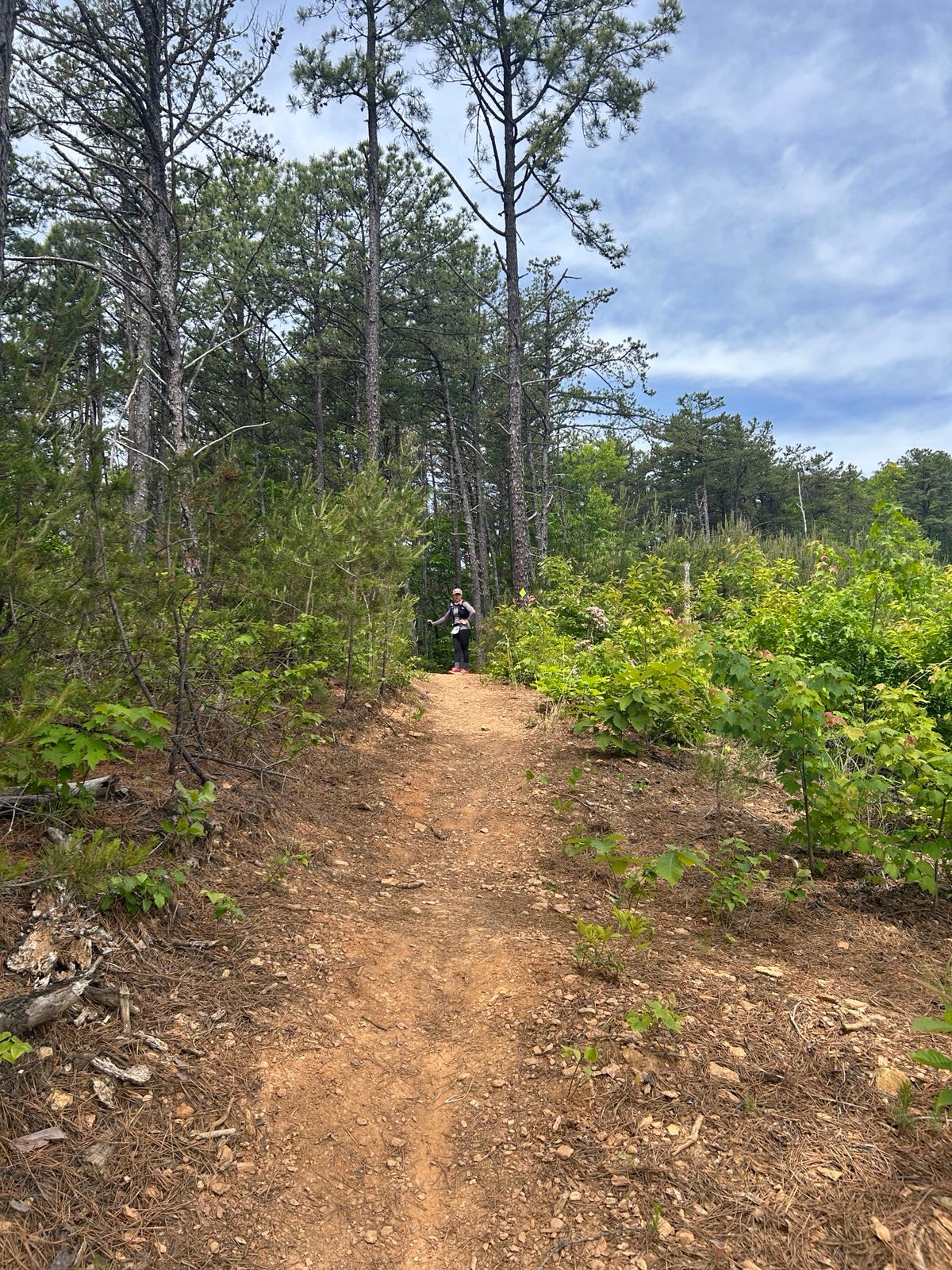
Of all the memories from Hellbender, the final miles with my wife remain the most joyful.
She would probably laugh if I called it running. By that point I was wrecked. My gait was ugly. The pace was slow. It was some combination of hiking, shuffling, and occasionally pretending to run. At one point I was even hiding my pace from my bride.
What still amazes me is that she agreed to pace me at all.
Karla does not consider herself a runner. She does not particularly enjoy running. Yet much like her cooking, something she also claims not to enjoy, she is remarkably good at it.
The difference between Karla and my other pacers was immediate.
She was the only pacer I could not impose my stubbornness on. She led. She took point. She navigated. She set the pace.
She seemed to float over the terrain. Bounding from climb to rolling hill to rocky descent. Often she’d stop, turn around, and smile while waiting for me to catch up. Then she’d turn and head down the trail again.
Meanwhile, I was out there personally disproving every motivational quote I’d ever posted.
Her joy never seemed to diminish. The contrast was hilarious.
And she did all of it with grace.
“Are we going to start running?”
“Let’s run that.”
“You’ve done everything right.”
Every correction came wrapped in encouragement. Every push came with a smile.
At one overlook she stopped and pointed toward the mountains. Layer after layer of blue ridgelines stretched into the distance. The afternoon air carried the smell of sun-warmed pine and fresh mountain growth.
“It’s beautiful.”
As I limped my way toward her from the rise below, I remember thinking something I wisely kept to myself.
Yes. You are.
Somewhere during those final miles my Garmin finally died. Thirty-three hours of navigation had exhausted the battery. Probably a good thing.
By that point I was fully submitted to Karla’s navigation and pacing anyway.
Months before the race, I had spent time reflecting on surrender. Now I was following my wife through the mountains.
“You’ve done everything right.”
“I’m proud of you.”
Those words carried more weight than I can adequately explain.
Somewhere in those final miles, the burden started lifting. The race did not get easier. The pressure to perform. The need to prove something. The endless calculations about pace, outcomes, and expectations. The internal noise that had followed me for so many miles began to quiet down.
I had enjoyed much of the race already. The mountains were beautiful. The front fifty miles had felt almost magical at times. But this felt different. I was no longer trying to manage the experience.
My wife was leading the way through the mountains. The ridgelines stretched endlessly into the distance. We laughed. We talked. We moved forward together.
Nothing about those miles was easy. But they were good.
I expected Hellbender to be difficult. I expected it to hurt. I did not expect some of my favorite moments to come after everything had already fallen apart.
I don’t remember every mile from those final twenty. I remember her smile. I remember her encouragement. I remember her leading. And I remember realizing that dependence was not failure.
It was grace.
Months earlier, I had written that suffering reveals more than it creates.
Hellbender gave me the opportunity to find out if I believed it.
Soli Deo Gloria