
The Weight
Iron Forge 2026 — Part 2 of 3

We left Hampstead early Thursday morning, nineteen men spread across trucks with packs stacked in the back, coffee and energy drinks in hand, conversation coming and going in waves. Some of the guys talked like nothing had really started yet. Some were quieter than usual.
That says more. The question was already in front of them whether they were reaching for it or not.
What does it mean to be a man of God?
Not something to answer on the drive. Not something to settle with a clever line. Something you walk into and let the Lord press on over time.
By the time we rolled into Davidson that Thursday afternoon, it still felt manageable. Packs hit gravel. Buckles clicked. Guys adjusted straps, shifted weight, tightened waist belts, and did that last bit of moving around that makes a man feel like he still has some say over what the load is going to feel like. The mountain air had that cool, damp smell to it, earth and leaves and water somewhere close by. It felt good. Light, even.
That’s the last moment before the truth starts to settle in.
Before we stepped off, we met Jon.
He was in his eighties. I told him he was a young eighty-something and he smiled like he appreciated the joke but had already lived long enough not to need it. He was fishing alone. Said his wife had died years ago. Said he had moved to the mountains after that, looking for something. He did not make it into a story. He said it straight. There was something on his chest, some device helping him along, and his health was clearly not what it used to be. But what stood out was not weakness. It was longing. He wanted to get back on the trails. He wasn’t trying to conquer anything. He just wanted to be out there again. We stood with him and prayed before we ever touched the trail, hands on shoulders, boots in the gravel, asking the Lord to meet him in his loneliness and strengthen him where he was fading.
Then we picked up the packs and stepped off.
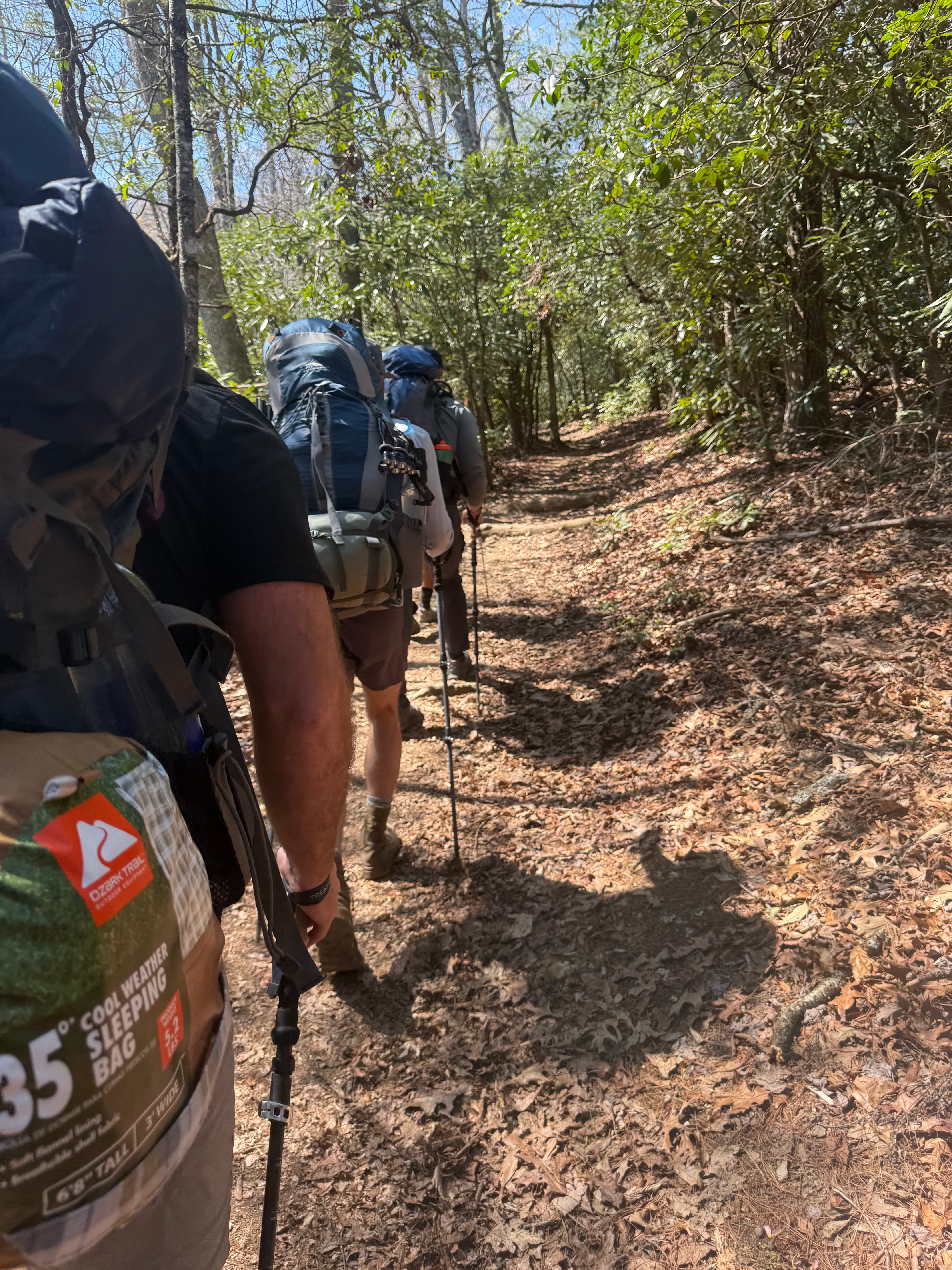
The first half mile lies to you.
Flat ground. Easy footing. Bikes rolling by. A stroller on the path. Dogs. It feels more like a park than the opening move of something about to expose you. Guys are still talking. Still joking. Still carrying themselves the way they intended to be seen. Then the bridge comes. Wood under boots, hollow sound, and after that the trail disappears into the side of the mountain and goes up.
The tone shifts there.
I pushed the pace early on purpose.
Prayerfully. That mattered. If that push had come from pride, it would have been off the mark. But there is a method to helping a group commit to the trail before the trail commits them back. Pressure surfaces things conversation never will. Within a few miles the line stretched on its own. Stronger hikers drifted forward without making a show of it. Others settled into rhythm behind them. The spaces between men got wider. The back began to form.
Ben was there from the start.
He wasn’t the strongest physically. He wasn’t the fastest. He was in the caboose because that was the pace his body set. But that is only half of what was happening. Ethan, carrying eighty pounds and somehow stoked about it, chose to stay back there too. That was his place of ministry. He was not back there because he had to be. He was back there because he had already decided that no one would get left alone in the rear if he had anything to do with it. Joel eventually moved that way too, seeing the same thin place in the line and stepping into it without being told.
So the caboose became its own kind of ministry. Ben was the pace there. Ethan was the covering there. And what could have turned into exposure turned into brotherhood instead.
By a few miles in, the talking thinned out. It didn’t drop all at once. It started to disappear. Guys stopped finishing thoughts. Breathing got louder. Boots scraped rock and loose dirt. Packs shifted against shoulders with that little creak nylon makes under tension.
The smell changed too. Spring leaves and dry woods gave way to sweat, dust, and effort. That is when the weight fully introduces itself. Not just the load on your back, but everything else you carried in with you that normal life lets you keep hidden. Pride. Image. Fear. The need to manage how you are seen. The habit of talking your way around what you have not actually lived yet. That is when the question starts landing deeper.
Jacob leaned into that kind of thing early. He kept finding the Lord in every step, not in a performative way, but in a way that felt like he was actually looking for Him there. When I told the guys to ground their rucks at a stop, he later told me it reminded him that sometimes a man needs to be told to set the weight down, not to stay there, but in preparation to pick it back up and get back on mission and faithful labor. That was Jacob all weekend. He kept seeing metaphor where most of us were still just feeling effort. It was amazing to watch him seek the Lord that way in real time.
Jackson was the opposite kind of early energy. He was having fun right away, hanging from tree branches at pacing stops, carrying that loose kind of confidence younger men often have before something has really asked them to pay for it. I loved seeing that in him. Play is not the enemy.
But the pressure has a way of revealing energy without killing it. By later in the day, the extra movement had settled. He still had light in him, but it had gone quieter, deeper, more focused. He was not burning energy anymore. He was placing it. And somewhere between the early play and the later pressure, something in him started shifting. You could see him stop performing the hike and start entering it.
Thursday kept compressing.
That lesson always shows up. We started later than planned. The miles did not care. The schedule tightened. Daylight started fading. It happens every year in one form or another. A man thinks he has time, thinks he can manage the day, thinks there will be margin later. Then later comes and there isn’t. That is a good lesson, even when it is inconvenient. Especially then.
We finally came into camp later than expected that night, packs dropped with more force behind them, smoke from the fire starting to cut through the sweat-and-dirt smell that had settled into shirts and skin. We still gathered. S’mores. Firelight. A good campfire.
And the usual camp conversations made their rounds. Who had already gone. Who was still holding it. Who picked the wrong spot. It came up more than once. It always does.
Not because everyone had plenty left in the tank, but because there was still enough life in the group to laugh, sit close, and carry the question a little further before sleep.
I woke up early Friday morning to make coffee.
The air was cold enough to bite your hands.
I crouched over the Jetboil, working the French press slowly,
watching the steam push up through the dark.
That smell hit first. Strong, bitter, familiar.
It cut through the damp air and the sweat still sitting in yesterday’s clothes.
I stood there for a minute with the cup in my hands, letting it settle me before anything else started.
Camp was quiet in that thin way it is just before people start moving.
A zipper somewhere. Someone shifting in a tent. A low cough.
Steam rising off the cup in the half-light.
There is something about being up before the group that lets you feel the weight of the day before anyone speaks into it.
I felt it then. Not heavy in a crushing way.
Just present.
Waiting.
Thank You, Father. Thank You for Your grace and mercy.
Then the camp slowly came alive. Breakfast. A group talk. Not rushed.
Then solitude.
I told the guys to spread out. Find a place. Get alone. Sit with their thoughts.
Sit with the Spirit.
You could see it in how they moved.
Some walked further than they needed to. Some stayed close but turned away.
Packs set down. Backs against trees. Heads lowered.
No phones.
No talking.
Just space.
That mattered more than the schedule. It always does.
We never make our first morning time hacks. We never do.
There are things the Lord does in stillness that no clean timeline can compete with.
These are the moments that stay.
A young man sitting alone with what rises in him when there is nothing left to distract him.
Then we picked the packs back up and moved toward Pilot.
By midday Friday we reached the base of Pilot Mountain and grounded the rucks.
It felt like a basecamp of sorts, not because the hard part was over, but because everyone knew in some unspoken way that something in them was about to be asked for. That was when Bob and Judy came by in the Forest Service truck. Older, steady, practical. They gave us some trail intel first. Then Bob looked at the group and asked if the boys would like to hear about the history of Pisgah National Forest. He had that look in his eyes, hopeful, almost excited, like a man wanting to pass something on while he still could. Easy yes.
They stood there and listened. So did I. Then we prayed over Bob and Judy, and over their grandchildren, and picked the weight back up again.
Pilot is the feature of the trip.
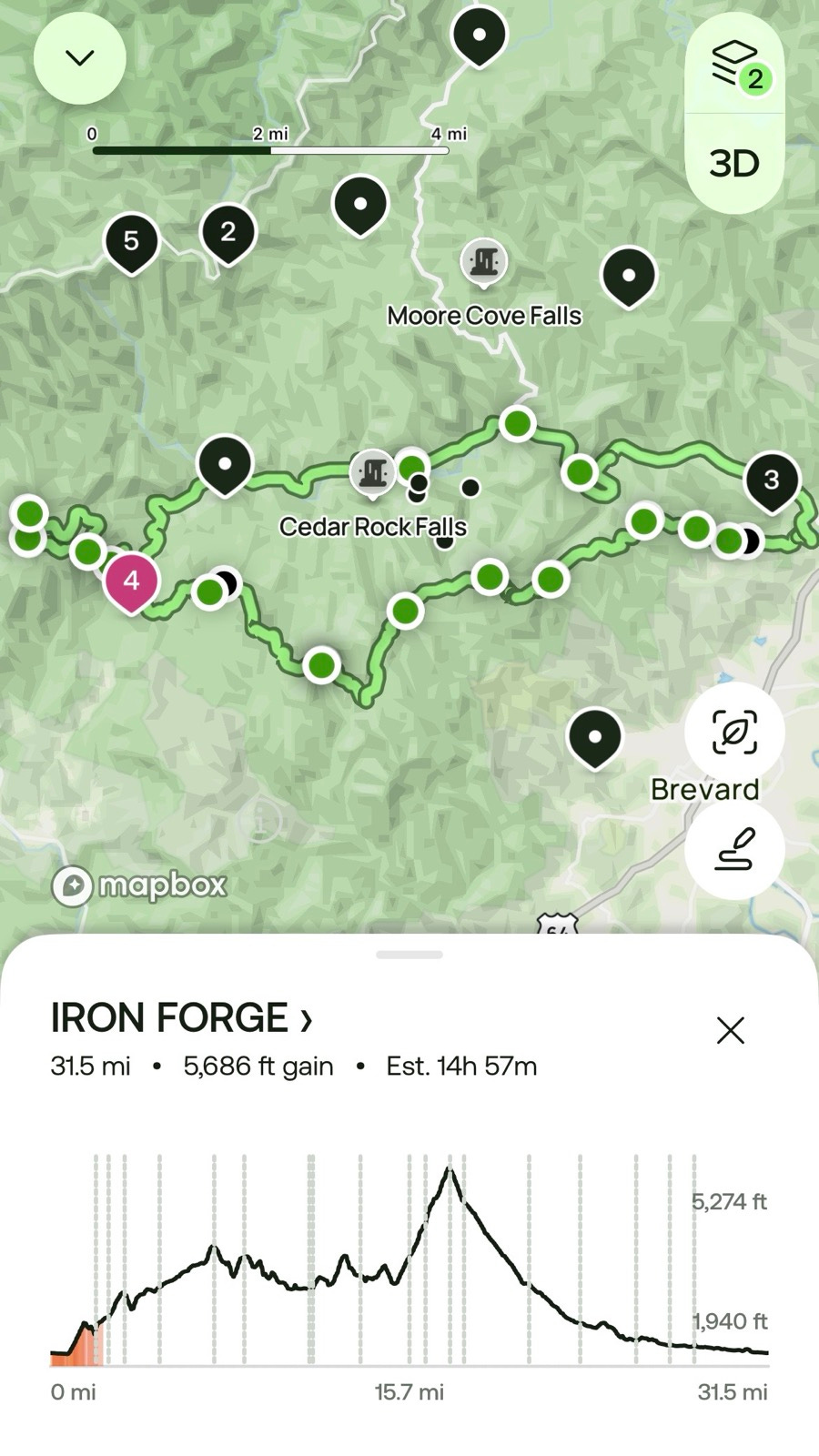
Not just because it stands up on the elevation profile like a middle finger, though it does. Not because it is the obvious climb, though it is. It is the feature because that is where the metaphor and the reality stop being separate things. The switchbacks. The isolation. The false summit. The rituals we carried into it. The weight each man chose and the weight each man had to accept. All of it converges there.
Pilot does not hit you all at once. It tightens around you. The switchbacks start working on a man slowly. You turn. Climb. Turn again. See just enough to believe progress is simple, then realize you are looking at the same mountain from another angle. The line stretches thinner here than it had all day. You stop hearing the group almost completely. Even when men are close, it does not feel shared. The world narrows to the sound of your own breathing, the scrape of boots on rock, the pull of the pack, the sweat running into your shirt, and the next turn you cannot read.
This is where false summits start preaching.
You look for signs that you are closer than you are. A break in the trees. A little flattening in the trail. A turn that feels like it should open something up. It doesn’t. The switchbacks keep bending. The mountain keeps asking. That is where negotiation gets exposed. A man starts bargaining with expectation itself. This should be enough. This should have been the top. This should have given me relief. But it doesn’t. And now he has to decide again.
Levi was behind me on that stretch. I could hear the shift in his movement before I ever looked back. Steady. Controlled. Tighter. More deliberate. Breathing deeper. Controlled, but costing him something. He did not ask how much was left. He kept taking the next step. It said more than any speech would have. It is one thing to talk about trust. It is another to stop needing a clear picture ahead and keep moving when all you have is the next step. That’s part of why that moment stays with me. He was not moving like a guy who felt strong. He was moving like a guy who had already decided to stay.
Turner looked different on that climb too. Unpolished. Raw. There was grit there, but not the kind that performs for anyone. It was the kind that refuses to stop. The kind that will crawl if it has to. I appreciated watching him climb Pilot because it showed the real thing. Not the Instagram version of resilience. Just a young man fighting the hill in front of him and staying in it. Later he would say life is going to be hard and you have to keep moving even if it is slow. He was talking about the mountain. But not only the mountain.
This is also where Ben’s story needs to be told right.
Ben was in the caboose the whole trip because he was the slowest. That is simply true.
But that is not the whole truth. The deeper truth is that from the back of the line, under the heaviest kind of exposure a slower pace can bring, he might have been the strongest man there spiritually. He was the most honest. The least interested in pretending. The most willing to let each step actually be taken with Jesus in mind. He carried that knife for his son from the beginning, but he also carried something even heavier than that: an honesty and vulnerability that the rest of the men, young and old, respected the hell out of because they knew it was real. He did not talk like a man trying to sound spiritual. He talked like a man who had already stopped hiding.
Later, he put words to what had been happening in him:
“I’ve been thinking a lot about humility. It’s easy to put humility in a box and think of it as downplaying yourself when you accomplish something. I think that is how I casually view humility, from the perspective of success.
True humility comes from the realization I have nothing to offer. I have no strength of my own. I have no gifts of my own. Everything I am has nothing to do with me, and everything to do with Who gave it to me.
There was a sense of freedom and relief sitting on the mountain, completely empty and realizing I had literally nothing to offer. No more pressure to perform or impress. Everything about me had completely failed, and His strength was my only option.
But His grace is sufficient for me. His power is made perfect in my weakness.
So I can walk humbly with Him, knowing I am nothing and He is everything. I don’t have to impress Him (I can’t). I can humbly lead my family, pointing them to Him (because I can’t do it myself).
There are broken pieces of my pride left on that mountain. And it hurt. But it hurt so good, because there is so much joy and freedom walking in humility.”
The other men felt that. You could see it in the way they listened to him, the way his words landed because his steps had already proven them true.
At the base of Pilot we told the dudes to pick up a rock.
Not a random rock. A rock to represent the weight they carry, especially the weight they choose, clutch, protect, and even idolize. Not the weight God actually asks them to carry. The other weight. The dead weight. The self-chosen weight that drains a man because he keeps returning to it like it belongs. They were to carry that rock up Pilot, then surrender it at the top. Not throw it away thoughtlessly, but set it down in a stack, an Ebenezer, an Abraham stone pile, something marked and remembered. Not because a stone can carry it away, but to name what won’t die on its own.
Ben did not carry one rock. He carried five. One for each member of his family. His wife and kids back home. He carried them all the way up and placed them in that stack at the top. That changes the feel of everything when you know it. He was already in the caboose. Already carrying the slower pace. Already carrying the knife for his son. Then he carried five stones too. Quietly. No drama. Just obedience.
The summit did feel like triumph. But it also felt like a pause long enough to see what had happened.
Rucks came off more slowly there. Guys stood around, still somewhere inside the climb, breathing hard, not in a hurry to talk. The wind moved through the brush. Sweat cooled on skin. You could smell dirt, leaves, and men who had been under load for hours. Then the moments started coming.
Ben handed the knife to his son.
No speech. No performance. No attempt to force meaning onto the moment. Everything that gave it meaning had already been carried. That is why it landed the way it did. It had miles behind it. Exposure behind it. Honesty behind it. The knife itself was never the point. The carried thing was the point. The man carrying it was the point.
The other men received their knives.
Then came the stones.
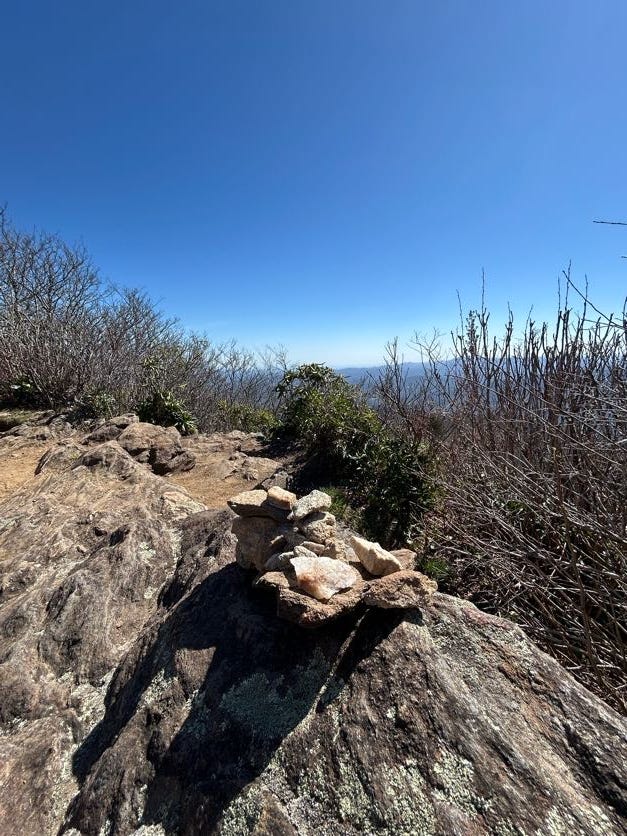
Guys stepped forward and set their rocks down in the pile. Weight they had chosen. Weight they had named. Weight that did not belong anymore. Levi had carried a big rock all the way up, and when he later reflected on it, he connected it to sin, to the useless weight he kept holding onto, unlike the responsibilities in his pack that were actually his to carry. That image stayed with him because he had lived it with his body before he ever turned it into words.
That is Iron Forge at its best. Truth leaving the mouth and taking form in action.
Friday afternoon opened back up after that.
Less compression. More space. Side-by-side walking instead of strict single file. The kind of movement that makes room for real conversation. Not the deepest conversations of the trip maybe, but genuine ones. Men getting to know one another. Something broke loose. Brotherhood took shape in a quieter key.
Even the jokes came back. Jokes and smells. The kind you only earn after a day like that. Light, not so light, but real.
That death-march road section was a Plan B on paper, but in retrospect it held its own kind of value. The climb exposed. The side-by-side afterward connected.
Saturday morning came fast. Same cool mountain air. Same damp smell. Same bodies, but not the same men. We stood in a circle again with the same question from the trailhead.
What does it mean to be a man of God?
This time no one was reaching for the right answer. They spoke from what they had actually lived. Short. Honest. Unpolished. Real. Some of those young men had learned something out there. Not because we handed it to them. Because it had been pressed out of them. More than a hike.
Then we packed up and headed home.
The road sounded the same.
The men did not.
And the mountain was not the hero of that.
God was.
The trail did not create anything new. It doesn’t fix a man.
It exposes. Presses. Strips away what doesn’t hold.
That is why the hike shows a man what he actually walks on.
Miles are not holy.
Suffering is not the point.
But chosen pressure has a way of showing a man what he actually walks on when everything else falls away.
Soli Deo Gloria
Next: Alignment — what a man does with what he now knows.